Real vs Fake Waterproofing: How IP67/IP68 Type-C Connectors Actually Seal
IP67/IP68 Type-C sealing processes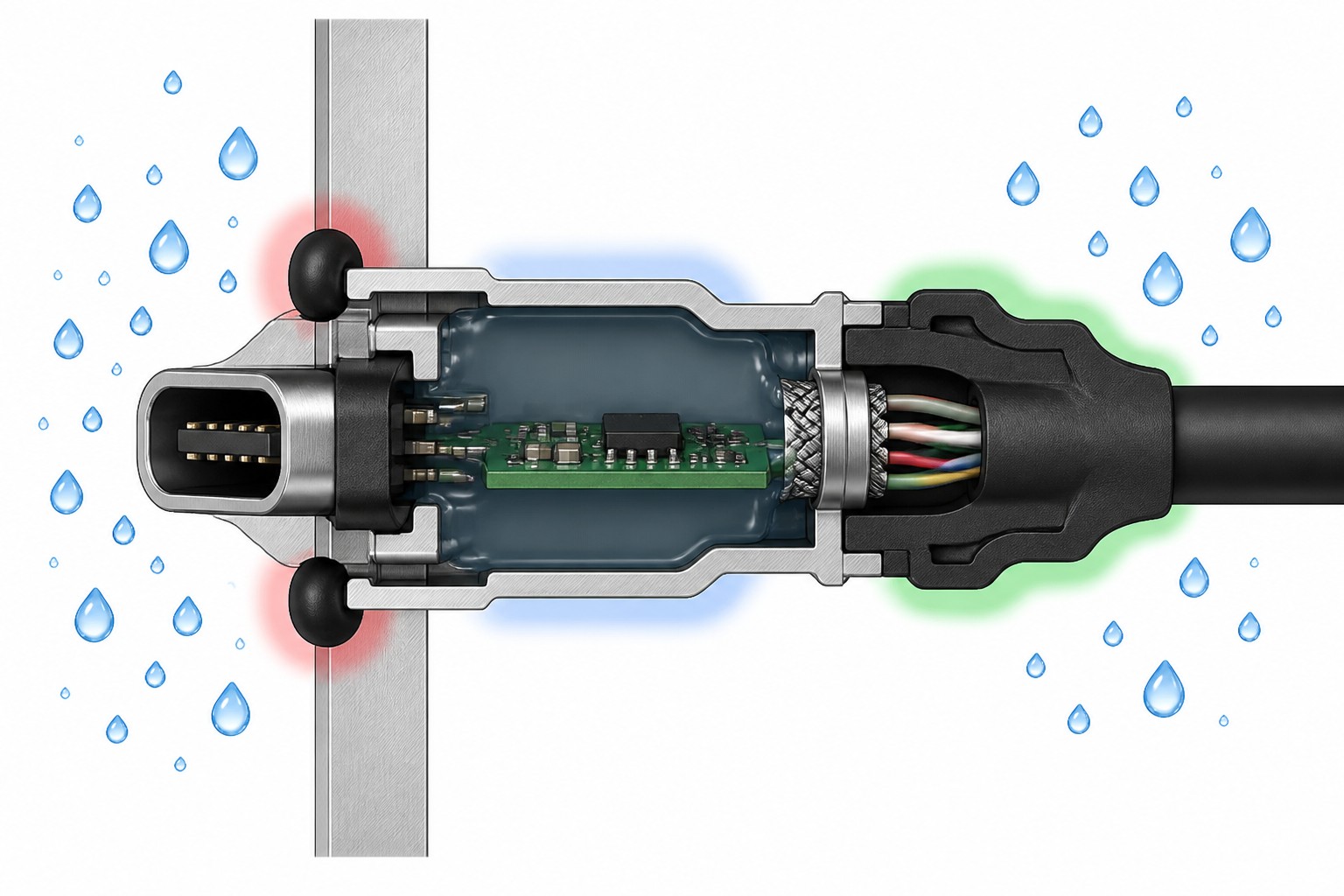
Fig. 8: Real waterproof Type-C is the result of three processes working by location — O-ring, potting and overmolding — not a marketing word.
Bottom line first
“Waterproof” is a system property proven by testing, not a word on a datasheet. A truly waterproof Type-C seals through three processes divided by location: O-ring/flat gasket (serviceable sealing faces), potting (non-serviceable cavities), and overmolding (the cable-tail transition). To judge real vs fake, ignore slogans and check three things: whether the IP rating definition is rigorous, whether a test report exists, and whether the unmated state also has a sealing plan.
1. What IP ratings actually mean
Rating Meaning Test condition
IPX5 Water jets 6.3 mm nozzle at 3 m
IPX6 Powerful water jets 12.5 mm nozzle, strong flow
IPX7 Temporary immersion 1 m depth for 30 minutes
IPX8 Continuous immersion Beyond 1 m; depth defined by vendor and verified
IP67 Dust-tight + IPX7 Dust chamber 8 h + 1 m immersion 30 min
IP68 Dust-tight + IPX8 Dust-tight + continuous immersion (vendor-defined depth/duration)
Two notes: ① IPX7 only covers 1 m / 30 min — it is not unlimited waterproofing; ② IPX8 depth and duration are vendor-declared (e.g. 1.5 m/30 min or 3 m/2 h) — declarations must come with test reports.
2. Three sealing processes: each owns a zone
Process Principle Serviceable Where
O-ring/flat gasket Elastomer compressed to fill gaps ✅ Yes Panel-to-connector interface, mated faces
Potting Epoxy/UV resin fills the cavity ❌ No PCB cavity, terminal roots, sealed zones
Overmolding Plastic molded over cable tail ❌ No Cable-to-connector transition, strain relief
Real waterproofing = the combination: O-ring on the panel face (serviceable, easy rework), potting inside for the PCB (blocks liquid paths), overmolding at the cable tail (seals and resists bending). A “waterproof” claim relying on a single seal usually leaks somewhere.
3. Four signals of “fake waterproofing”
IPX7 claimed with no test report: real waterproofing has third-party (or traceable internal) test records; fakes only have datasheets;
No unmated-state solution: a “waterproof connector” tested only mated, with no cap/seal plan for the unmated state, will leak in the window;
No seal structure: open the sample — no O-ring, no potting residue, held together by “interference fit” alone; thermal cycling will open it;
No salt spray/environmental data: outdoor and marine applications also need salt spray (IEC 60068-2-11 / ASTM B117), UV and thermal-cycle data; immersion alone is not a complete story.
4. FAQ
Q1: IPX7 or IP68 — which to choose?
A: By application: occasional immersion (rain, splash, brief drop) → IPX7 is enough; continuous immersion or underwater devices → IP68, and confirm the vendor-declared depth/duration matches your duty cycle.
Q2: Can potted areas be repaired?
A: Potted zones are non-serviceable, but design separates serviceable parts (panel gasket, connector body) from non-serviceable ones (potted cavity) — replace what failed, no whole-unit scrapping.
Q3: Can a Type-C connector reach IP68?
A: Yes, with all three interfaces (mated, panel, cable) satisfied and the test conditions declared. JBL’s IPX7 series (e.g. USB-20C-F-01EM02, USB-20C-MF-01TL waterproof extension) is verified at 1 m/30 min; higher ratings are customized and validated per your duty cycle.
Q4: How do I verify a supplier’s claim?
A: Three steps: ① request test reports (IPX7/IP68, salt spray, thermal cycling); ② require first-article immersion sampling; ③ re-test once in your own condition (e.g. 30 cm tank, 2 h). Testing is cheap; failure is expensive.
5. Selection advice (data source: this product series’ protection rating)
Waterproofing is not mysticism — it’s verifiable engineering. JBL Electronics’ panel-mount Type-C series (jbl-ec.com) is designed to IPX7 (O-ring sealing + structural fit), with immersion-verified 1 m/30 min for both panel receptacles and waterproof extension cables; higher ratings (IP68, salt spray, specific depths) are customized and co-validated per your duty cycle. When inquiring, state: required rating, environment (outdoor/marine/industrial) and unmated time — we deliver the sealing plan and test schedule. Demand reports, not slogans.
Post time: Oct-30-2026
