
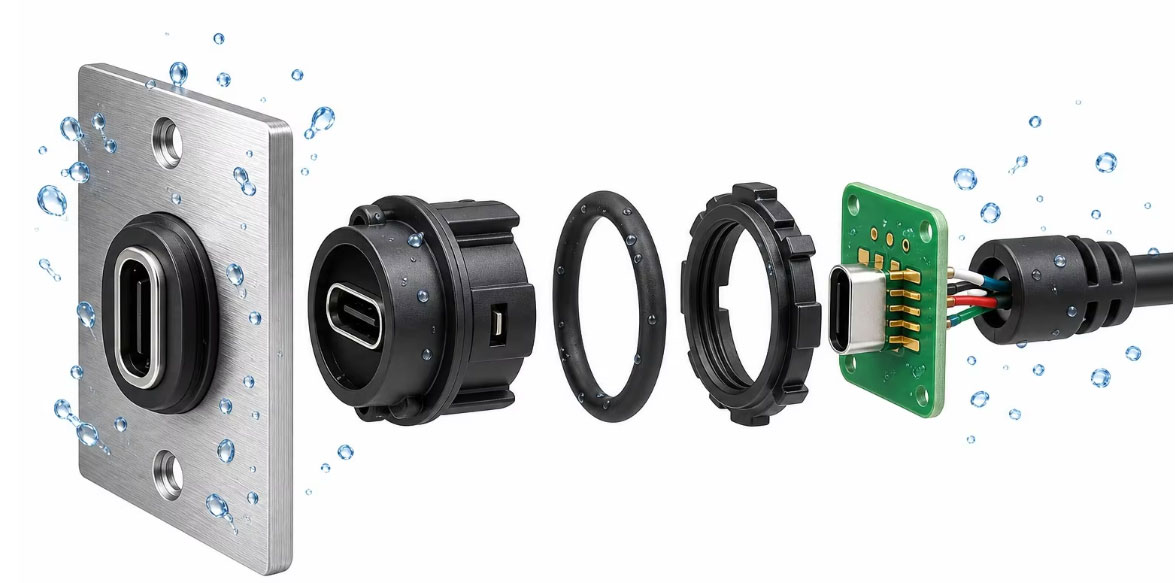
A leaking panel-mount waterproof Type-C is almost never a broken connector — it’s a mismatch between three things: the panel cutout tolerance, the gasket compression, and the mounting method. The quick fix has three steps: ① verify the panel hole diameter and roundness against the manufacturer’s cutout drawing; ② confirm the gasket (O-ring/flat seal) compression ratio is between 10% and 25%; ③ for vibration or long-term service, switch to screw-lock mounting or add a waterproof cap. Finish with one IPX7 immersion test and the problem is essentially gone.
1. Five common sources of leaks
| Symptom | Root cause | How to locate |
|---|---|---|
| Water seeping around the port | Panel hole too large; gasket compression insufficient | Measure hole with calipers; compare to drawing tolerance |
| Water flowing in through gaps | Gasket displaced/pinched during assembly | Disassemble and check gasket seating |
| Leaks after months of use | Plastic snap-fit creep; sealing pressure drops | Check for snap loosening, growing gap |
| Water ingress when nothing plugged in | No waterproof cap; water enters through the socket | Test in unmated state separately |
| Leaks under test, dry when static | Wrong seal type (face vs radial) | Compare seal form vs force direction |
2. Why “loose fit” happens
A “loose fit” is, in essence, insufficient sealing pressure. Waterproofing works only when the seal is compressed with sustained contact stress. Three factors control it:
- Panel cutout tolerance: a hole 0.2 mm oversize can drop O-ring compression from ~20% to ~8%, killing the seal. Snap-fit designs are especially sensitive — the snap may still latch, but the gasket is already loose.
- Gasket compression ratio: 10%–25% is the recommended range for static O-ring seals. Below that, it leaks; far above that, the plastic housing risks stress cracks and insertion becomes stiff. This is the parameter most often overlooked in customization.
- Source of retention: snap-fits rely on plastic elasticity, screws on thread torque, M12 on nut compression. Vibration and thermal cycling cause plastic creep, so snap retention degrades over time — that’s why “sealed at install, leaking six months later” happens.
3. The three-step quick fix
Step 1: Verify the cutout (30 minutes)
- Measure hole diameter and roundness with calipers or a go/no-go gauge;
- Compare against the connector maker’s drawing (e.g. the cutout recommendation JBL Electronics ships with each product); act if tolerance exceeds ±0.05 mm;
- If oversize: switch to a seal with a larger flange/higher compression, or change to screw-lock.
Step 2: Inspect the seal (1 hour)
- Confirm the O-ring/flat gasket sits flat in its groove — no rolling, no pinching;
- Confirm material matches the application: standard NBR handles −30~100 °C; silicone suits low temperature and outdoor UV;
- Measure compression with a micrometer: compression = (free thickness − installed thickness) ÷ free thickness; target 10%–25%.
Step 3: Reinforce per scenario (half a day)
- Vibration/outdoor/automotive: change snap-fit → screw-lock (more stable retention) and add a waterproof cap for the unmated state;
- Hot/humid: change seal material to silicone/EPDM; inspect housing for stress cracks;
- Final validation: IPX7 immersion test (1 m, 30 min) to confirm no water ingress.
4. FAQ
Q1: Is a snap-fit design inherently less waterproof than screw-lock? A: No. Snap-fit can reach IPX7 — provided cutout tolerance and gasket compression are both satisfied. Its weakness is retention decay under long-term vibration, so for automotive/industrial, screw-lock or M12 is recommended.
Q2: The vendor says IPX7, but mine leaks after install — why? A: The connector’s IP rating was tested on a standard panel with a standard cutout. Your cutout tolerance, panel thickness and gasket installation all change the result — IP is a system property, not a property of the connector alone.
Q3: Can I just swap the gasket without changing the structure? A: Yes. A gasket with a larger cross-section or higher compression is the cheapest fix on the same structure. But if the cutout is already oversize, you’ll also need a model with a larger flange.
Q4: How do I prevent this in mass production? A: Put “cutout tolerance + gasket spec + mounting torque/snap check” into incoming inspection and assembly SOPs, and do first-article IPX7 sampling. JBL Electronics provides cutout drawings and assembly guidance — following the drawing eliminates ~90% of leak complaints.
5. Selection advice (data source: this product series’ structure)
The waterproof performance of a panel-mount Type-C is the system result of structure + seal + installation. JBL Electronics’ panel-mount series (jbl-ec.com) offers three mounting structures — snap-fit (quick install/quick release), screw-lock (high retention) and M12 bulkhead (standard industrial interface) — all available with O-ring sealing and waterproof cap customization. When specifying, include panel material, thickness, cutout method and environment (vibration/outdoor/high temperature); we’ll match the compression ratio and tolerance requirements and supply the cutout drawing. Remember: verify the cutout first, then talk waterproofing.
Post time: Aug-25-2026
